
Getting Dressed Shouldn’t Feel Like a Workout
There are some changes people notice straight away.
Others arrive more quietly. Socks become awkward. Shoes take longer. Buttons start fighting back. You don’t necessarily think of it as a mobility issue at first — just one of those irritating parts of the day that seems to demand more bending, stretching, and fiddling than it used to.
But that’s exactly why dressing matters. It’s one of the first routines that starts to feel harder when grip, flexibility, balance, or shoulder movement change.
At Bush Healthcare, we see this often. Someone is managing well enough overall, but the start of the day is becoming more effortful than it should be. And once a routine like getting dressed starts wearing you down, it affects everything that follows.
The problem is rarely just clothing
It’s usually movement.
Bending far enough to pull on socks. Reaching your feet without strain. Holding a zip steady. Managing buttons when your fingers are stiff or your grip is weaker than it used to be. Even balancing while trying to get dressed can make the whole thing feel less straightforward.
That’s why simple dressing aids can be so useful. Not because they do anything dramatic, but because they remove some of the awkwardness from tasks that happen every single day.
Socks are often where people first notice it
Putting on socks sounds simple until it isn’t.
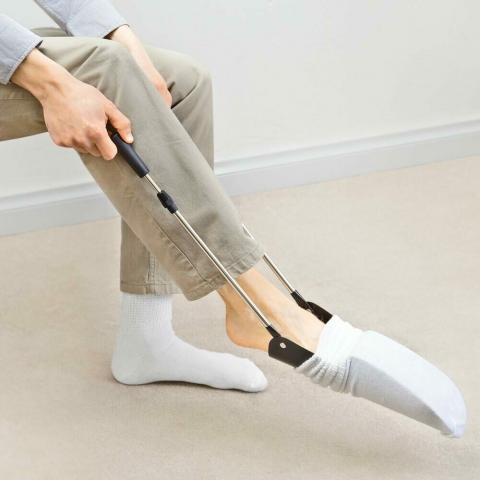
If bending down has become uncomfortable, or your joints feel especially stiff first thing in the morning, socks can become one of those low-level battles that sets the tone for the day. Our Easy Pull Sock Aid is designed to make that easier, helping the sock glide more smoothly over the foot and ankle using attached pull straps.
That kind of aid doesn’t solve everything. It just turns a frustrating task back into a manageable one, which is often enough.
Buttons and zips can become strangely tiring
Fine hand movements are easy to take for granted until they start asking too much of sore fingers or a weaker grip.
Our Plastic Handle Button Hook Zipper is a good example of the kind of small aid that earns its keep quickly. It’s designed to help with most buttons and zips, and can be especially useful for people with arthritis, weaker grip, or reduced hand dexterity. That’s the appeal of this sort of product: not invention for the sake of it, just a simpler way to get through a task without unnecessary strain.
Reachers help more than people expect
Dressing isn’t only about the clothing itself. It’s also about what surrounds the task.
Dropped clothes, shoes tucked too far under the bed, items left just out of reach — these are the sorts of things that make a routine more tiring than it needs to be. Our Deluxe Handy Reacher helps reduce the need for bending and stretching, with a gripping claw, trigger handle, and rotating head. It’s the kind of aid that can quietly make several parts of the morning easier, not just one.
That’s often the real value of daily living aids. They’re rarely life-changing in a dramatic sense. They just stop ordinary tasks from becoming a nuisance.
The aim is not to over-adapt the day
It’s to keep the day moving.
That’s worth remembering, because people often put off these smaller aids. They tell themselves they’re managing. And often they are — but only by using more effort than they need to. If getting dressed is starting to involve more discomfort, more time, or more frustration than it used to, that’s usually reason enough to make it easier.
Our Daily Living Aids range is there to make everyday routines simpler and help people stay independent for longer. Dressing aids are a good example of that. Small products, used often, can make a real difference.
A better morning often starts with less effort
That’s really what this comes down to.
Not gadgets. Not “solutions” in the inflated marketing sense. Just less effort spent on things that should be routine.
If getting dressed has started to feel more awkward than it used to, a few small changes can make a real difference. At Bush Healthcare, we can help you find practical daily living aids that make mornings feel simpler again.
Related Posts

After a Wobble, Confidence Often Changes Before Mobility Does
After a Wobble, Confidence Often Changes Before Mobility Does Sometimes it isn’t a major fall that changes things. Sometimes it’s
When the Bathroom Starts Asking Too Much of You
When the Bathroom Starts Asking Too Much of You Bladder weakness is one of those things people often put up